
Epson Australia publishes third Sustainability Impact Report charting a year of measurable progress
Epson Australia has released its third Sustainability Impact Report, covering the 12 months to March 2026, detailing environmental performance, community investment and the role of resource-efficient technology in reshaping local manufacturing.
The report lands at a significant moment for the company. FY25 was the final year of Epson's corporate vision, Epson 25 Renewed, which ran from 2021 to 2025 and delivered progress across technological innovation, business growth and environmental sustainability. A headline milestone from that period was Epson becoming the first Japanese manufacturer to achieve 100 percent renewable electricity use across all global sites.
Building on that, Epson has set out its next long-term vision, Engineered Future 2035, which commits the company to advance engineering excellence while creating corporate and social value, with the stated aim of enabling people and the planet to thrive together.
Against a 2017 baseline, Epson has achieved a 35 percent reduction in absolute Scope 1, 2 and 3 greenhouse gas emissions, moving towards a target of 55 percent by 2030. The company has reaffirmed its commitment to becoming carbon negative by 2050.
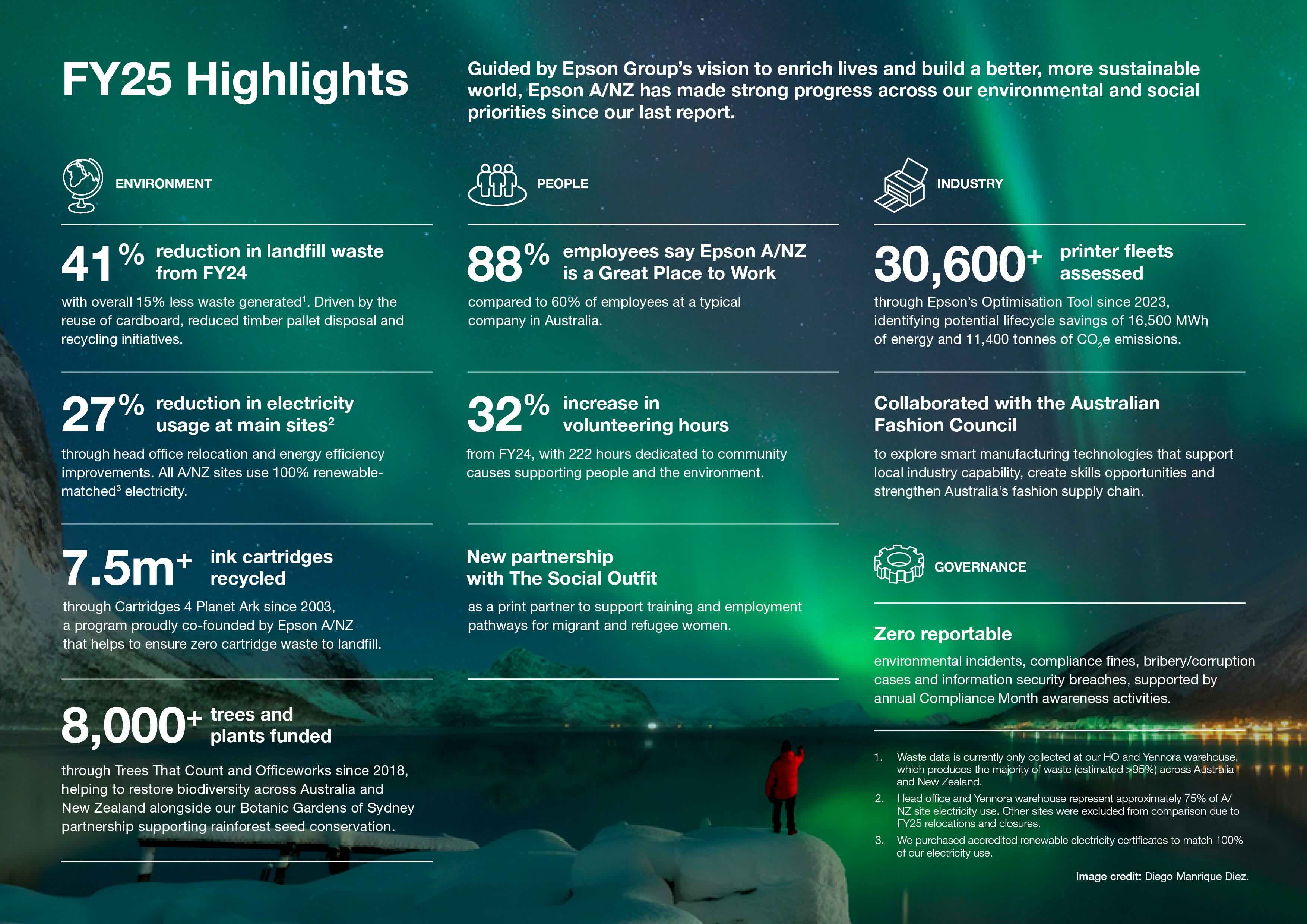
Epson Australia and New Zealand have translated that global ambition into regional outcomes. The report records a 27 percent reduction in electricity usage at main sites1, driven by the relocation of the Sydney head office in November 2024 and ongoing energy efficiency improvements. All Epson sites across Australia and New Zealand are powered by 100 percent renewable electricity and will continue to be.
Waste performance moved sharply as well. Landfill waste fell 41 percent from FY24 through cardboard reuse, reduced timber pallet disposal and expanded recycling2. More than 21.7 tonnes of used Epson cartridges have been collected and recycled through the Cartridge 4 Planet Ark program, which operates on a zero-waste-to-landfill basis.
"We publish our Sustainability Impact Report because we think people deserve to see the full picture, not just the good news," said Craig Heckenberg, Managing Director of Epson Australia and New Zealand. "That means sharing the numbers that show where we still have work to do, as well as the ones we are proud of. Our customers, partners and staff put their trust in us and we would rather earn that trust with honesty than with a polished claim. Publishing each year also keeps us honest with ourselves, because the next report has to answer for the last one."
Heckenberg said the commitment extends well beyond the reporting cycle. "This is not something we do for a single year or a single announcement," he said. "It is a long-term effort and it touches everything from how much electricity our sites use to the work we are doing alongside local manufacturers. There is still a lot ahead of us and we are grateful to the people and partners who are on that journey with us. We will keep publishing this report, and we will keep listening to what it tells us."

Craig Heckenberg, Managing Director of Epson Australia and New Zealand
The report highlights Epson’s work with the Australian fashion industry as a practical demonstration of how on-demand digital textile printing can support a more sustainable fashion future by reducing waste, enabling more responsible production and strengthening local manufacturing.
A key milestone over the past 12 months was the announcement of a feasibility study commissioned by Australian Fashion Council, supported by Epson and Investment NSW to establish Australia’s first-of-its-kind Clothing Smart Factory. This nationally significant initiative aims to rebuild sovereign manufacturing capability while advancing a more sustainable model of fashion production.
Epson also partnered with Australian apparel manufacturer Citizen Wolf to showcase smart factory manufacturing in operation, supporting the Australian Fashion Council’s National Manufacturing Strategy and its five key priorities for boosting productivity, reducing waste and accelerating innovation through sustainable technology. The initiative offers local manufacturers a practical roadmap to revitalise and future-proof their operations.
For an industry built on forecasting demand months ahead and absorbing the cost of what does not sell, on-demand production is not a marginal improvement. It addresses the structural waste at the centre of the apparel supply chain and Epson's printing technology sits directly behind it.
Epson Australia was certified as a “Great Place to Work” during the reporting period, recognition of its investment in a positive and inclusive workplace. Mental health and wellbeing remained a priority throughout the year, particularly in a dynamic and customer-facing environment, with continued investment in resilience programs, leadership development and access to professional support.
Community engagement continued through corporate partnerships, in-kind contributions and employee volunteering. Epson has contributed 222 hours of staff time to community and social initiatives since the release of its first Sustainability Impact Report.
Sustainability reporting has moved from a communications exercise to a commercial one. Procurement teams, partners and large customers increasingly ask suppliers to evidence their environmental performance and public reporting of this kind gives them something verifiable to work with rather than an assertion in a sales conversation.
The value runs both ways. A report that covers progress, challenges and learnings gives an organisation a clear view of where it stands and it lets readers across every market Epson operates in compare intention against outcome. The third edition also matters for continuity. Trends become visible across years and a company that publishes annually has to demonstrate movement rather than restate ambition.
The full Epson Australia Sustainability Impact Report is available at https://www.epson.com.au/impact-report/index.asp
[1] Head office and Yennora warehouse represent approximately 75% of A/NZ site electricity use. Other sites were excluded from comparison due to FY25 relocations and closures.
2 Waste data is currently only collected at our HO and Yennora warehouse, which produces the majority of waste (estimated >95%) across Australia and New Zealand.